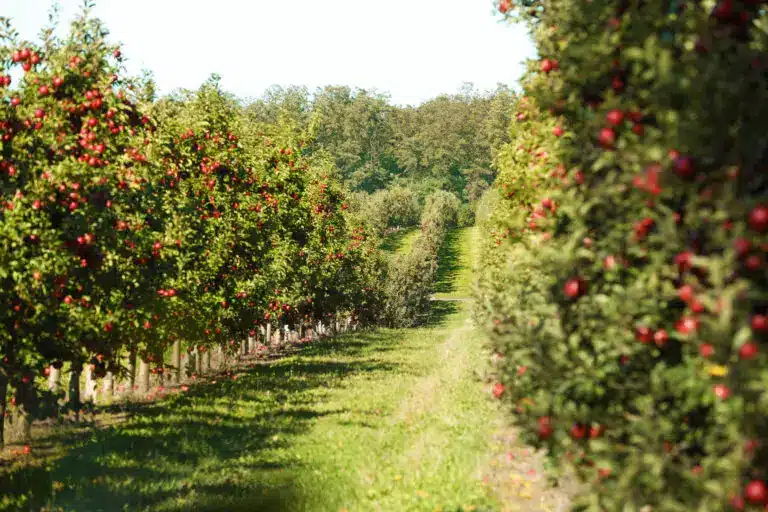
Agritech in horticulture includes much more than robotics and increasingly spans the entire supply chain, from orchard and crop planning through labour, spraying and harvest management to packhouse automation, quality control, inventory, traceability and export documentation.
A significant and growing market
New Zealand is a particularly attractive agritech market because of its export orientation and the high value of its crops. Horticulture export revenue is forecast to increase by 7% to NZ$9.5 billion in the year to 30 June 2026, driven by record kiwifruit and apple volumes and elevated kiwifruit prices.[1]
The industry’s long-term ambition is equally significant. The Aotearoa Horticulture Action Plan aims to double the farmgate value of horticultural production by 2035 while improving prosperity and environmental outcomes. Science, skills, technology and better use of data are central to the plan.[2][3]
Australia provides a substantially larger and more diverse market. Australian horticulture reached a record production value of A$18.4 billion in 2024–25, an increase of 6% on the previous year. Fresh produce exports reached approximately A$3.5 billion, up 13%, and have more than doubled over the past decade.[4]
Research commissioned by Hort Innovation estimated that widespread adoption of productivity-enhancing innovation could add approximately A$1 billion annually to Australian horticulture’s value added by 2040.[5] This illustrates why adoption, not simply invention, is becoming a central focus for the sector.
Where agritech is being applied
Farm and orchard management software
Digital farm-management systems are replacing paper records, spreadsheets and disconnected applications. They can connect labour, harvest, produce inventory, quality, spray records, traceability and packhouse operations while supporting payroll, accounting and reporting integrations.
Growers increasingly expect information to flow securely between systems, providing a reliable and timely view of their operations.
AgriTech New Zealand’s current work focuses on interoperability, secure and consistent movement of data between platforms, and defining what an “adoption-ready” solution looks like in practice. Australia has also been developing a Data Interoperability Framework to support data exchange, digital traceability and closer alignment between industry and government systems.[6]
Sensors, computer vision and artificial intelligence
AI and sensing technologies are increasingly being applied to practical horticultural tasks, including detecting pests and diseases, estimating crop loads, forecasting harvests, monitoring fruit quality and improving irrigation decisions.
New Zealand’s Plant & Food Research is combining biological knowledge, sensing, imaging, modelling and AI to create digital orchard systems that can help predict how orchards will perform under different conditions. Australian and New Zealand projects are also testing AI-supported forecasting, autonomous machinery and precision crop management, with growing emphasis on measurable commercial outcomes.[7][8][9]
Robotics and automation
Labour shortages and rising operating costs are driving investment in autonomous vehicles, robotic weeding and spraying, automated harvesting, grading, packing and palletising.
Projects across Australia and New Zealand are increasingly moving beyond isolated trials towards commercial applications. However, successful adoption still depends on technology operating reliably in variable conditions and delivering a credible return on investment.[10]
Packhouse and supply-chain technology
Some of the fastest commercial returns may be found after harvest, where packhouses provide a more controlled operating environment than orchards and fields.
Technologies include automated grading, packing and palletising; produce inventory and cool-store management; electronic dispatch and freight documentation; grower payments and packhouse charging; digital traceability; and integration with accounting and other business systems.
Exporters are also under increasing pressure to provide dependable provenance, quality and compliance information. Traceability is therefore valuable not only for compliance, but also for customer service, recall preparedness and access to premium export markets. Australia’s national traceability strategy similarly identifies market access, interoperable systems and trusted supply-chain information as important priorities.
The challenge of agritech adoption
Agritech adoption is accelerating. Labour shortages, rising costs, climate pressures and increasing traceability expectations are pushing technology higher up growers’ priorities. Larger and more complex horticultural businesses also require integrated systems that improve visibility, consistency and decision-making across multiple farms and packhouses.
However, adoption remains uneven. Horticultural businesses are understandably cautious about technologies with uncertain returns, poor integration, connectivity limitations or inconsistent performance under commercial conditions. Seasonal workloads and concerns about data ownership, cybersecurity and long-term vendor support can also slow uptake.
Australia benefits from greater market scale and investment, while New Zealand’s smaller, export-focused industry supports close collaboration between growers, researchers and technology companies.
Technologies with the strongest prospects in both countries will be those that:
- Solve a clearly defined operational problem.
- Deliver measurable improvements in labour, cost, yield or quality.
- Integrate with existing systems and workflows.
- Perform reliably under commercial conditions.
- Are supported by effective implementation, training and ongoing service.
What this means for horticulture businesses
For horticulture businesses, the opportunity is moving beyond digitising individual records towards creating a more connected view of the operation.
Growers and packers are likely to place increasing value on:
- Real-time visibility of labour, inventory and production.
- Traceability captured as part of normal workflows.
- Systems that can adapt to the business without extensive custom development.
- Straightforward integration between operational, payroll, accounting and reporting systems.
- Reliable mobile and offline capability.
- Clear improvements in cost control, productivity, quality and decision-making.
The best technology investment will not necessarily be the most advanced. It will be the one that solves a genuine operational problem, fits the way the business works, connects with existing systems and delivers a credible return.